

Empowering Urban Resilience: Generators for Cities and Municipalities
When the grid goes down in a city, the consequences ripple outward fast. Traffic signals fail. Emergency dispatch centers lose power. Water treatment pumps stop. Vulnerable residents in shelters, public housing, and care facilities are left without climate control or lighting. Municipal generators exist precisely to prevent that cascade — standing ready to absorb load the moment utility power falters and hold every critical public system online until normal supply is restored. For local governments, backup power isn’t a budget line item. It’s public safety infrastructure.
Enhancing Disaster Preparedness and Emergency Response

Hurricanes, ice storms, flooding, seismic events — urban infrastructure faces threats that utility grids simply cannot always withstand. Cities and municipalities that have invested in distributed backup power across their critical facilities respond faster, recover faster, and protect more lives when those events occur. Emergency response centers, hospitals, water treatment plants, communication networks, and public shelters all require independent power sources capable of sustained operation — not just a few hours of runtime, but days if necessary. That’s the standard municipal generators have to meet.
What Size Generator Is Best for Cities and Municipalities?
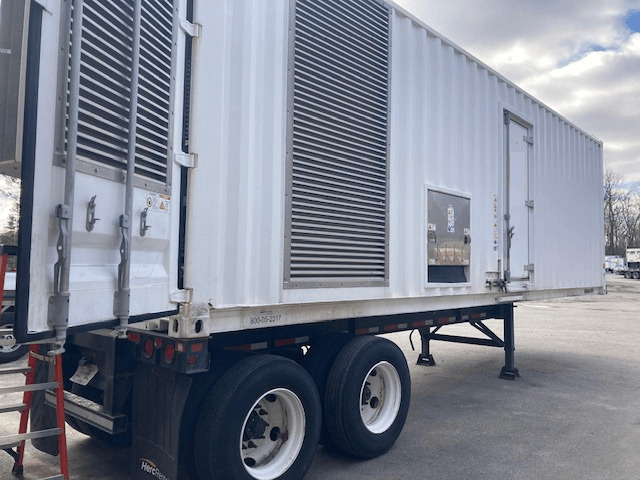
Size selection for municipal applications is driven by the specific facility and its critical load profile. Small municipal departments — traffic management offices, small public works buildings, satellite fire stations — can be adequately covered by 65 kW generators, which handle traffic signals, lighting, basic HVAC, and communications without excess capacity. Larger facilities serving substantial populations — emergency operations centers, water treatment plants, city halls with multiple active departments — need the output headroom that 125 kW generators provide to sustain concurrent high-draw systems through an extended outage. The decision between these benchmarks should always start with a facility-level load assessment, not a budget conversation.
Generator Models Suited to Municipal and City Applications
For smaller municipal facilities and departmental backup power needs, the Caterpillar XQ60 trailer-mounted diesel generator is a compact, mobile 60 kW unit that handles the essential load of traffic infrastructure, small public buildings, and emergency lighting systems cleanly and reliably. Larger city facilities requiring sustained backup power across multiple critical systems are a better match for the Caterpillar XQ125 trailer-mounted diesel generator — a proven 125 kW unit that can be rapidly deployed to emergency operations centers, water facilities, or municipal campuses and commissioned quickly when time is critical.
Shop Municipal Generators by kW Range
Smaller city departments, satellite facilities, and traffic infrastructure applications typically fall within our 50kW–74kW generators for sale. Larger municipal operations centers, public safety facilities, and city infrastructure requiring sustained multi-system backup power belong in our 100kW–249kW industrial generator range — output levels with sufficient headroom to keep every critical public service operational through an extended grid outage.
Tailored Power Solutions from Turnkey Industries

Municipal power requirements vary enormously — a small rural township and a major metropolitan district face fundamentally different challenges. Turnkey Industries works with city planners, public works directors, and emergency management coordinators to match the right generator to each application. Our inventory spans the full output range, every unit ships thoroughly inspected and load bank tested, and our team understands the procurement timelines and documentation requirements that municipal buyers typically navigate. We’ve supplied generators to municipal facilities across the country. We know the work.
Looking to Buy or Sell a Used Generator for Municipal Use?
Public sector procurement cycles move on their own timeline, and surplus equipment disposal is its own challenge. Turnkey Industries handles both sides of that equation. We carry one of the largest used industrial generator inventories in the United States — units at 70 kW, 100 kW, and beyond, all inspected and ready to ship from Texas with fast lead times. If your municipality has decommissioned equipment to offload, our buying program puts value back on surplus assets — submit your unit for a quote here. To discuss your current power backup requirements, reach out to our team.
What Types of Generators Are Available?
Municipal applications demand flexibility, and our inventory delivers it. Browse used generators, new units, trailer-mounted configurations for rapid deployment, permanent standby systems, diesel-powered and natural gas options across our full inventory. If the exact specification you need isn’t currently listed, contact us — we source equipment continuously and can often locate specific units on shorter timelines than you’d expect.
Renting Generators for Municipal Emergency Response
Capital budgets, procurement timelines, and board approval cycles are realities of municipal government — but power emergencies don’t wait for any of them. When a city’s permanent backup generator fails during an active weather event, when a natural disaster overwhelms installed capacity across multiple facilities simultaneously, or when a planned infrastructure project requires temporary power during a switchover, municipalities need rental equipment deployed fast. Stag Rentals provides industrial generator rentals sized for municipal applications, with rapid deployment capability and the capacity to support government and municipal emergency power needs across Texas. For coastal cities and Gulf Coast municipalities managing annual hurricane season exposure, Stag’s contingency power planning program pre-positions rental equipment under contract before storm season — so that when a major storm threatens, the city’s emergency operations center, water treatment facilities, and public shelters already have committed equipment rather than competing in a regional scramble for whatever’s left available. Emergency generator rentals are also available for unplanned outage situations requiring immediate dispatch.
Frequently Asked Questions: Generators for Cities and Municipalities
What procurement vehicle can municipalities use to purchase generators without going through a full competitive bid process?
Several cooperative purchasing contracts allow municipalities to procure generator equipment without issuing a standalone RFP. GSA Schedules, SOURCEWELL (formerly NJPA), BuyBoard, and OMNIA Partners contracts are commonly used by local governments for equipment purchases. Texas municipalities can also use the Texas Local Government Purchasing Cooperative (BuyBoard) or the Texas Association of School Boards (TASB) cooperative for eligible purchases. These cooperative vehicles satisfy competitive procurement requirements while dramatically shortening lead times — a critical advantage when a generator is needed quickly. Confirm with your city attorney or purchasing officer which cooperative contracts your jurisdiction has adopted before proceeding.
How do we prioritize which municipal facilities get generator backup when budget doesn’t cover everything?
Start with life-safety facilities — emergency operations centers, fire and police stations, emergency shelters, and facilities housing vulnerable populations (senior centers, dialysis clinics under municipal operation). These are non-negotiable from both a legal liability and a moral obligation standpoint. Next tier is critical infrastructure continuity — water and wastewater pumping stations, traffic signal master controllers, communications infrastructure. Third tier is operational continuity — city hall, public works facilities, IT infrastructure. Document this prioritization in your Continuity of Operations Plan (COOP) and emergency management plan. FEMA Hazard Mitigation Grant Program (HMGP) funding may be available to offset generator costs for life-safety facilities following a presidentially declared disaster.
What is the difference between a standby generator and a prime power generator for municipal applications?
Standby generators are rated for intermittent use — they run during outages and then shut down when grid power returns. Standby ratings assume limited annual operating hours, typically under 200. Prime power generators are rated for continuous extended operation as a primary power source. For most municipal backup applications — emergency operations centers, fire stations, city halls — standby-rated equipment is appropriate. For facilities that may need to run on generator power for weeks following a major disaster, or for remote municipal facilities where grid access is unreliable, prime-rated equipment provides better long-term reliability. Running a standby-rated generator as a primary power source for extended periods voids warranties and accelerates wear significantly.
How should a city structure its generator maintenance program across multiple facilities?
Establish a centralized maintenance schedule managed by the public works or facilities department rather than leaving it to individual department heads. Monthly exercise runs of 30 minutes minimum under load should be logged for every generator in the municipal fleet. Annual load bank testing verifies that each unit can carry its actual emergency load — something that monthly no-load or light-load exercises don’t confirm. Maintain a maintenance log for each generator including oil changes, filter replacements, coolant checks, battery condition, and any anomalies observed during testing. If your city has more than 5 to 10 generators across facilities, consider a managed maintenance contract with a local generator service provider rather than relying on in-house staff who may not have engine-specific training.
Can municipal generators be used to power temporary emergency shelters during a disaster?
Yes, and pre-planning this capability is far more effective than improvising it during a disaster. Identify your designated shelter facilities in advance — typically schools, community centers, or large public buildings — and assess their electrical infrastructure for generator compatibility. Many shelter facilities lack adequate transfer switching for generator connection, which means either a manual connection through a properly rated inlet with load shedding, or pre-installation of a transfer switch. FEMA and state emergency management agencies have guidance on shelter power requirements and may have pre-positioned generator assets available for municipalities participating in their programs. Coordinate with your county emergency management office to understand what state and federal generator resources can be requested during a declared emergency to supplement municipal assets.
What documentation do we need for FEMA reimbursement of emergency generator rental costs following a disaster?
FEMA Public Assistance (PA) reimbursement for emergency generator costs requires documentation of: the declaration number for the disaster event, a detailed scope of work describing why the generator was necessary and which facility it served, rental agreement or purchase documentation with clear cost breakdowns, proof of payment, and records showing the generator was used for an eligible purpose at an eligible facility. Time-stamped delivery records, fuel purchase receipts, and operator logs strengthen the reimbursement claim significantly. FEMA PA reimbursement applies to both rental costs and purchased equipment in some cases — coordinate with your state’s FEMA PA program office early in the recovery process to understand what documentation standards apply to your specific situation.