

What Size Generator Does an Airport Need?
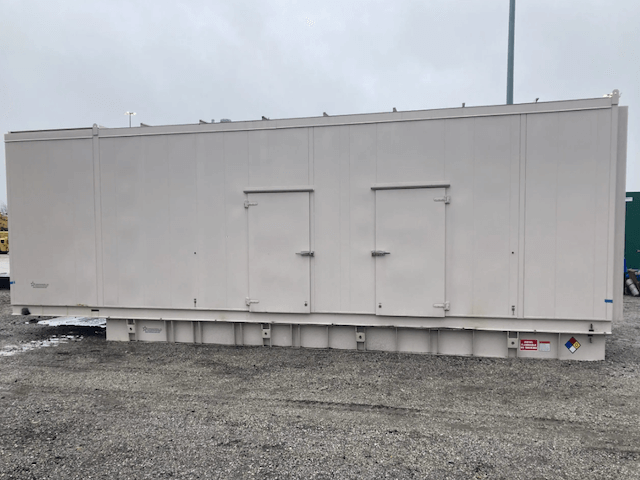
It depends on what has to stay on. A regional airfield holding security, communications, and basic airfield lighting through a power outage has nothing like the power requirements of a commercial terminal running baggage carousels, jet bridges, air traffic control systems, and full terminal air conditioning at the same time.
Rough bands that hold up in practice: a small regional airport usually lands between 125 kW and 350 kW of standby power. A mid-size commercial airport with one or two concourses runs 500 kW to 1000 kW. A large terminal complex at one of the busiest airports in the world needs 1000 kW to 2500 kW, almost always split across more generators rather than one machine. A load study drives the number, not terminal square footage.
Why Is Airport Power Backup Non-Negotiable?
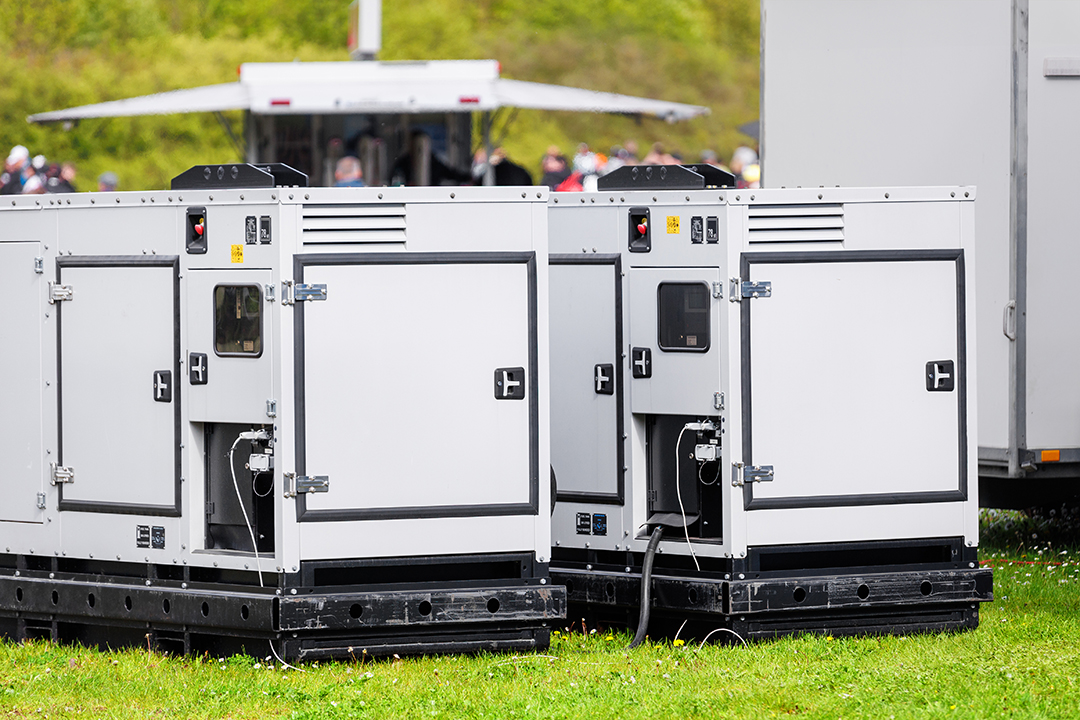
Airports operate on the assumption that electricity is always there. Runway and taxiway lighting, instrument landing systems, air traffic control communications, baggage handling, boarding gates, security screening, and the systems that monitor all of it are built around continuous power.
A thirty-second grid failure at a hotel is an inconvenience. A power failure at an airport grounds planes, generates regulatory incident reports, and brings the terminal to a grinding halt. Flight delays cascade across the network for the rest of the day, airlines absorb lost revenue, and passengers sit at boarding gates with no boarding pass printed. Pilots need airfield lighting and navigational aids running to land safely, which is why those circuits are treated as life-safety loads and not conveniences.
Backup generators remove that exposure. They pick up load automatically on grid failure, supply electricity for as long as there is diesel fuel on site, and hand the facility back cleanly when utility power returns. For airport operations that is a baseline requirement, not an upgrade.
What Are the Consequences of a Power Loss at a Terminal?
The serious consequences of an airport power loss are not limited to dark concourses. A single power failure in the wrong switchgear can stop a sort system mid-cycle, strand aircraft at gates with no jet bridge power, and shut down the screening lanes that hold air travel moving. Passengers back up into the curbside, flights miss their slots, and the disruption takes a full operating day to clear even after utility power is restored.
Reliable backup power is what keeps airports running smoothly through an event instead of recovering from one. Airports continue to serve flights during a grid outage only because the generator took load within seconds and held it. That is the whole purpose of emergency power generation at an airfield: uninterrupted operations, not a faster recovery.
Which Airport Systems Are Critical Systems?
Not every circuit in a terminal belongs on the emergency bus. Sorting the critical from the convenient is what keeps generator size and operating costs reasonable. The loads that almost always make the list:
- Airfield lighting — runway, taxiway, approach, and obstruction lighting
- Navigational aids — ILS, PAPI, beacons, and approach lighting systems
- Air traffic control — tower equipment, radar feeds, and radio
- Security — access control, surveillance, and screening equipment
- Fire and life safety — alarm, suppression, smoke control, and egress lighting
- Baggage handling — sort conveyors, baggage carousels, and screening
- Terminal essentials — jet bridges, elevators, data rooms, and partial air conditioning
Data rooms and air traffic control equipment usually sit behind UPS systems as well. A UPS covers the gap between the grid dropping and the generator taking load; it is not a substitute for power generation, since battery runtime is measured in minutes. The two work together — UPS for the transfer window, generator for the duration.
Standby or Prime Power for an Airport?
Most airport installations are standby generators sized for outage duty, because the utility carries the facility the rest of the year. A standby power rating gives you the most kW per dollar for a load you hope never to serve.
Prime or continuous-rated units come into play in two situations: an airfield where grid reliability is poor enough that the generator runs measurable hours every month, and a construction or terminal-expansion phase where temporary power distribution has to carry a working load for months. Running a standby-rated machine as a prime mover shortens engine life and costs more than buying the right rating up front.
Diesel generators are the standard across aviation for a simple reason: diesel fuel can be stored on site in the quantity codes require, and a diesel engine will carry full load for days. Natural gas units appear at airports in peak-shaving or non-emergency roles, where the gas line itself is the single point of failure that rules them out for life-safety power.
How Many Generators Does a Terminal Need?
Larger commercial airports almost always use distributed backup power rather than one large machine. Several industrial generators are installed across the facility, each assigned to a load zone. One failure does not take down the entire system, zones can be shed under load, and a unit can be pulled for maintenance without exposing the whole terminal.
Regional airports with simpler infrastructure often run a single primary generator with a smaller secondary unit behind it. Either way the architecture comes out of the facility’s critical load map. Adding more generators also spreads fuel storage across smaller tanks, which can simplify permitting and let the plant run more efficiently at partial load.
How Do You Size Generators for an Airport’s Future Growth?
Terminal expansions, electrified ground support equipment, and added screening lanes all raise power requirements years after the generator is installed. Sizing to today’s peak load alone usually means buying a second machine inside a decade.
The practical approach is to size the generator and the switchgear for the load you can document plus a defined margin, then confirm the paralleling capability exists to add capacity later without replacing what is already installed. Efficiency works against you at both ends: an undersized unit will not carry the load, and a badly oversized one loafing at 20% burns more fuel per kilowatt-hour and wet-stacks. Reliable power over a twenty-year service life comes from getting that margin right, not from buying the largest unit on the lot.
Are New or Used Airport Generators the Better Buy?
Used is where most of the value sits. A low-hour used industrial generator costs considerably less than new and does identical work, because standby units routinely come off a building with very few hours on the clock. Cost per kW is the comparison that matters.
New makes sense when a permitted permanent installation requires current emissions certification, when full factory warranty coverage is part of the specification, or when the configuration does not exist used. We stock new industrial generators for those cases.
Every used unit through our yard in Dickinson, Texas gets a 22-point inspection and is load bank tested before it ships, and it carries our 30-day IronClad warranty. For emergency generators that may sit idle for months before they are needed, documented load bank testing is the only thing separating a working machine from an assumption. That is why facilities teams treat a tested unit and a trusted partner as the same purchase.
Shop Airport Generators by kW Range
Regional airfields and airport support buildings generally find their match in our 100kW–249kW and 250kW–374kW generators for sale, with 375kW–499kW units covering larger regional terminals. Commercial terminals running concurrent high-draw systems should look at 500kW–669kW, 670kW–839kW, and 840kW–999kW industrial generators, and large terminal complexes at 1,000kW–1,199kW and 1,200kW–1,399kW units or above, where there is headroom to power every critical airport system at once without an overload event.
Buying or Selling Airport Generator Equipment

We hold one of the largest used industrial generator inventories in the United States, with units regularly stocked across the airfield power range. Everything ships from Texas on short lead times and arrives ready to run. Offloading equipment after an upgrade? We buy used generators outright — tell us what you have here.
What Types of Generators Are Available?
Our inventory covers used generators, new units, trailer-mounted configurations, standby systems, diesel, and natural gas options. If you have a spec and do not see the unit listed, call us — equipment moves through constantly and we can usually locate the components and power services you need faster than a procurement cycle. Contact us online.
When Does Renting Make More Sense Than Buying?
Planned maintenance shutdowns, generator changeovers during infrastructure upgrades, and emergency replacement when a permanent unit fails — those are the cases where a facilities team needs power capacity now and cannot wait on procurement. Stag Power Rentals keeps a fleet of high-capacity industrial generators available for short and long-term rental, deployable on short notice across Texas and beyond. For airports in hurricane-exposed coastal regions, a pre-season contingency power plan locks in equipment before a storm, which is crucial in a market where every facility in the region needs the same units the same week. Time-critical requests run through Stag’s emergency generator rental program for emergency support and rapid dispatch.
Frequently Asked Questions: Generators for Airport Facilities
What regulatory standards govern emergency power systems at commercial airports?
FAA Advisory Circular 150/5340-26 covers maintenance of airport visual aid facilities and references power system requirements for airfield lighting. NFPA 70 (National Electrical Code) and NFPA 110 (Emergency and Standby Power Systems) apply to the generator installations themselves. Airports certificated under 14 CFR Part 139 must meet FAA certification requirements that include provisions for backup power to runway lighting and navigational aids. TSA security directives may also impose requirements for continuous power to access control and surveillance. Coordinate with your FAA regional office and ARFF planning documents when specifying emergency power.
How quickly must an airport generator transfer load after a grid fault?
NFPA 110 sets transfer time by equipment class. Class X systems transfer within 10 milliseconds, typically life-safety loads on static transfer switches. Class 10 systems transfer within 10 seconds, which covers most airport emergency power applications including airfield lighting and air traffic control. The automatic transfer switch matters as much as the generator — a correctly sized unit paired with a slow or unreliable ATS still misses the requirement. Specify the ATS and generator together.
How do I calculate the generator load for a terminal baggage handling system?
Baggage conveyors are among the largest motor loads in a terminal. Collect nameplate horsepower for every motor in the system — sort conveyors, flat belt conveyors, claim carousel drives, and screening equipment. Convert HP to kW (1 HP is roughly 0.746 kW) for running load. Then take your largest single motor and multiply its running kW by 2.5 to 3.0 for startup surge. If motors start in sequence during system initialization, account for staggered surge across several of them. Most baggage systems are three-phase 480V — confirm generator output voltage matches before you specify.
What fuel storage requirements apply to airport backup generators?
NFPA 110 requires Level 1 emergency power systems to hold fuel for a minimum of 96 hours at full load. That is a floor, not a target — airports in hurricane zones or on aging grid infrastructure should plan longer. Above-ground tanks at airports are subject to FAA obstruction clearance requirements and may fall under EPA SPCC regulations if total aboveground on-site storage exceeds 1,320 gallons. Clear tank placement with your airport’s environmental compliance officer before installation.
How should airports load test generators without disrupting operations?
NFPA 110 requires monthly no-load or load tests and annual full-load tests for Level 1 systems. At active airports, full-load testing is normally scheduled in overnight low-traffic windows and coordinated with air traffic control to avoid conflicts with instrument approaches. Resistive load bank testing — applying load to the generator without switching the facility over — is the safest way to verify full-load capability annually without live transfer risk. Log every test date, load level, and anomaly; FAA inspectors and insurance underwriters ask for that documentation.
What does it cost to run an airport generator during an extended outage?
Fuel is the dominant operating cost. A 1000 kW diesel generator at 75% load burns roughly 55 to 70 gallons per hour, so a 96-hour outage runs 5,300 to 6,700 gallons. Add oil and filter service at the manufacturer’s hour interval and a post-event inspection. Those numbers are worth running before an event, because they determine whether tank size and fuel supply contract cover the outage duration the facility is planning for.