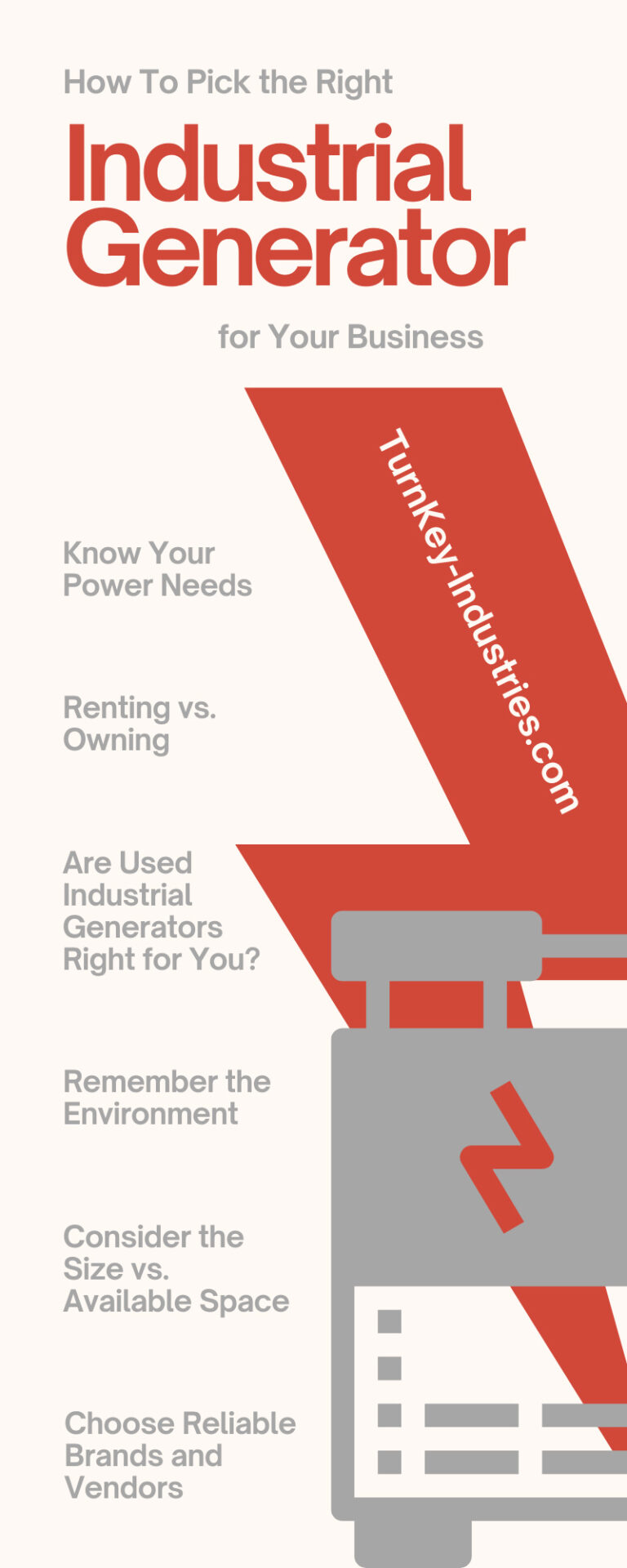
Choosing an industrial generator comes down to four decisions: what job the unit will do, how much power your site draws, which fuel fits your permits, and whether new or used suits your budget and timeline. Settle those four, then check the site conditions, and the list of suitable models narrows fast.
This guide walks through each decision in the order we use with buyers, from duty rating to vendor. Fuel choice carries regulatory weight, so review the EPA compliance requirements for stationary engines and your state air agency’s rules early, before a unit is on your shortlist.
Match the duty rating to the job the generator will do
Every generator set is published with a rating, and the rating describes how the unit is meant to run. Under the ISO 8528 framework, an emergency standby rating covers backup power during a utility outage, a prime rating covers variable-load power for unlimited hours in place of purchased power, and a continuous rating covers constant load for unlimited hours. Standby ratings allow no overload, and prime ratings commonly allow a 10 percent overload for one hour in twelve, though each manufacturer publishes its own definitions.
The duty rating also limits how hard the unit can be loaded over time. Manufacturers commonly rate standby and prime sets for an average load of about 70 percent of nameplate, so a set that will run heavily for long periods needs a higher rating or more capacity than a set that idles through most outages. Confirm the rating on the data plate or spec sheet before you compare prices, because two units with the same kW number can be rated for different work.
Build a load list, then size the unit with starting demand in mind
Sizing starts with the equipment, not the generator. List every motor, compressor, pump, chiller, and control system the unit must carry, note which loads start together, and decide which loads must stay online during an outage. Turnkey Industries stocks generators from 20 kW to 3000 kW, and our kW range pages let you browse by output once you have a target.
Running loads and starting demand
Add up the running loads first, then account for the starting demand of motors and compressors, which draw several times their running current for a short period. The largest motor on the list usually sets the requirement, because the generator has to hold voltage and frequency through that start while other loads are already running. A margin above the calculated total covers future expansion, and staging motor starts with soft starters or variable frequency drives can reduce the size of the unit you need.
kW, kVA, voltage, and phase
Generator ratings are often published in both kVA and kW, and the two differ by the power factor. Industrial sets are commonly rated at a 0.8 power factor, so a 500 kVA unit delivers about 400 kW. Match the generator to the voltage and phase your distribution equipment expects, which for most industrial facilities means three-phase service such as 120/208 volts or 277/480 volts, and confirm both on any unit before you buy.
Light-load operation and wet stacking
Oversizing has a cost on diesel units. An engine that runs at light load for long periods sends unburned fuel and soot into the exhaust system, a condition called wet stacking that reduces efficiency and shortens engine life. NFPA 110 addresses it by calling for monthly exercise of diesel sets for at least 30 minutes, either at 30 percent or more of nameplate rating or at the manufacturer’s minimum exhaust temperature, so a unit sized close to the load it carries is easier to keep healthy.
Fuel type sets your emissions and permitting path
Most of our inventory is diesel, with natural gas units available as well. Diesel sets store fuel in an on-site tank, so runtime depends on tank size and refueling access, and they accept load quickly after startup. Natural gas sets typically draw from a pipeline, which removes the refueling task but ties the unit to the utility gas supply, so a pipeline interruption during a regional event can take the generator down with the grid.
Fuel also changes how a unit fits a code requirement. The EPA regulates stationary engines by fuel type and use, with separate requirements for emergency and non-emergency operation. Ask for the emissions tier of any engine you consider so you can confirm it fits your permit. For systems with a 10-second transfer requirement, designers have noted that large natural gas sets can struggle to deliver power inside that window, so confirm start and load acceptance performance with the vendor if that applies to your site.
Life safety loads bring code requirements that change the purchase
If the generator will serve life safety or other regulated loads, NFPA 110 governs the system. It sorts systems into Level 1, where a failure could cost lives or cause serious injury, and Level 2, where a failure is less critical to life safety, and it assigns a type based on the maximum seconds allowed before power is restored. A Type 10 system must restore power within 10 seconds, which affects the start performance, transfer switch, and fuel supply you need.
Many industrial facilities fall outside Level 1 and carry loads such as process lines, refrigeration, HVAC, and data systems under Level 2 or optional standby rules. Your electrical engineer or local authority decides which designation applies, and it is worth settling that before you shop, because it determines runtime hours, installation location, and testing requirements.
New and used units each fit a different budget and timeline
Both routes produce a dependable power source when the equipment is tested and the vendor is reputable. The difference is price, lead time, and the technology on the nameplate, and the right choice depends on how soon you need the unit and what your project demands from it.
When a new generator fits
New units carry current engine and control technology and a full manufacturer’s warranty. They also carry the highest price, and a unit built to order has to move through the manufacturer’s schedule before it ships. If your project requires the latest emissions tier, a specific configuration, or a long warranty horizon, review our new industrial generators.
When a used generator fits
Used units cost less and are already built, so there is no manufacturing queue to wait through. Every used generator we sell is inspected and tested by a certified generator technician and load bank tested, which means the savings do not come from skipped verification. For a fixed budget or a tight schedule, browse our used industrial generators and compare hours, maintenance records, and test results unit by unit.
Site conditions decide where the unit can run
Place the generator on a stable pad with enough airflow for combustion and cooling, and plan for the weather it will face, from heat and snow load to hail. An enclosure or a weatherproof housing protects the unit in exposed locations, and a generator room needs ventilation sized to the engine’s air and cooling demand. If a listing does not state whether the unit is open or enclosed, ask before you buy.
Then confirm the unit fits the space. Compare the listed dimensions against your pad or room, and leave clearance around the unit for ventilation, service access, and exhaust routing. Check that the delivery route can handle the rigging equipment needed to set the unit, because a generator that arrives and cannot be placed adds cost and delay.
Plan the connected equipment at the same time. The transfer switch, fuel tank or gas connection, sound limits at your property line, and the conduit run between the unit and your distribution gear all affect cost and schedule, and they are easier to settle before a purchase than after delivery.
Buy from a vendor that tests units and publishes its terms
Judge a vendor by the depth of its inventory, the detail on its listings, and what customers say about the buying experience. Brand matters as well, and the established names in industrial power include Multiquip, Cummins, Kohler, and Caterpillar, all of which we carry. A vendor that lists specifications openly and answers dimension and configuration questions directly is easier to trust with a purchase of this size.
Before you commit, ask any vendor for the documents that prove condition and fit: the duty rating, engine hours, maintenance records, emissions tier, load bank test results, and the voltage and phase configuration. A vendor that supplies these quickly has usually done the testing, and one that cannot supply them is asking you to carry the risk.
- Duty rating (standby, prime, or continuous) and kW and kVA output
- Engine hours and maintenance records
- Emissions tier and fit with your permit
- Load bank test results under load
- Voltage, phase, and whether the unit is open or enclosed
Warranty terms belong on that list. All equipment we sell, new or used, carries our 30-day IronClad Assurance warranty, and the full terms are on that page.
If you are still narrowing down which size, fuel, and duty rating fit your facility, browse our full inventory and we will help match a generator to your load list.