Power interruptions cost commercial and industrial operations money every minute they last. An Oak Ridge National Laboratory analysis of U.S. outage costs estimated the average commercial and industrial customer outage at about $6,031 in 2024, and that figure does not capture spoiled inventory, missed shipments or damaged equipment at your specific site. A backup generator is the most direct way to take that exposure off the table.
Below are ten reasons we hear from businesses that decide to buy, with practical details on what to look for in each case.
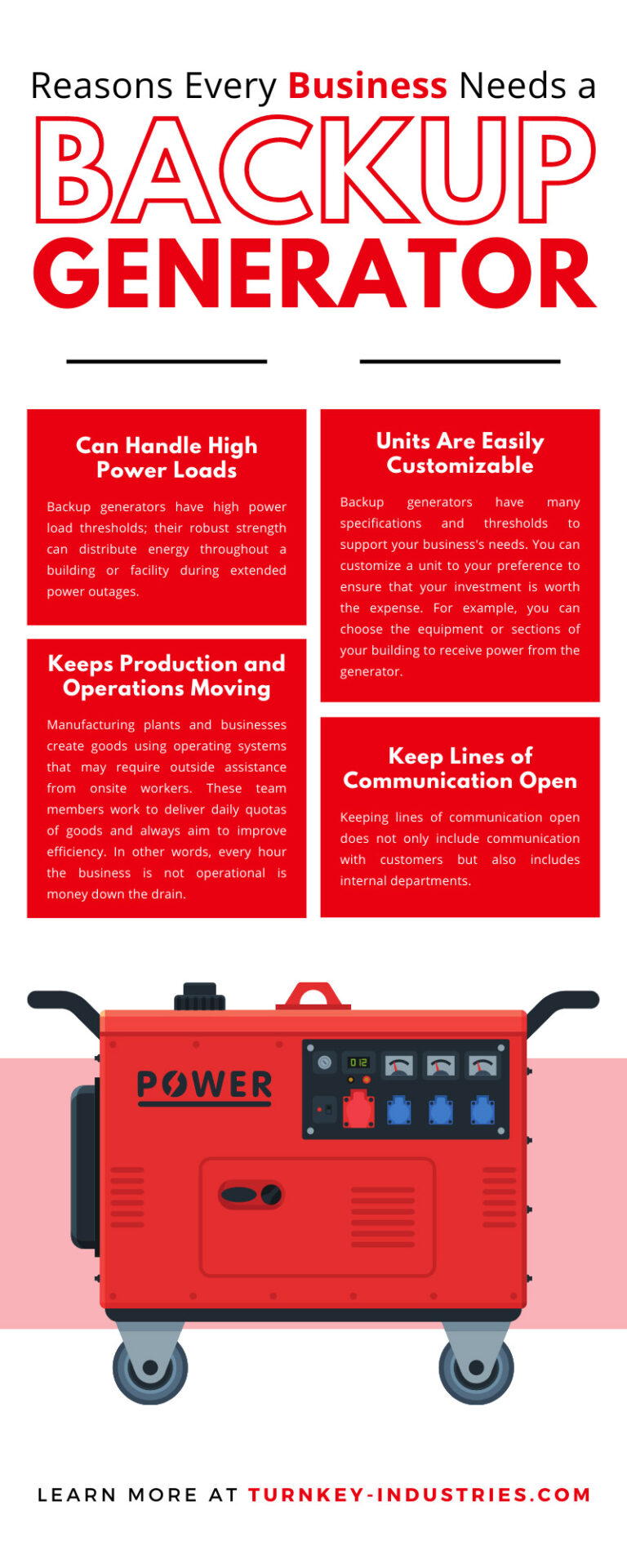
1. It Carries High Power Loads
Industrial generators are built for the starting currents and sustained demand of motors, compressors, chillers and production lines. Units run from about 20 kW to 3,000 kW, so you can match the machine to your load instead of shedding circuits. Our shop by kW page links to each size range so you can see what fits your facility.
2. Configurations Fit Your Site
Backup power is not one-size-fits-all. You can choose diesel or natural gas, new or used, open skid or weatherproof enclosure, and fixed or mobile mounting. Facilities that need flexibility often look at trailer-mounted generators, while permanent installations typically use industrial standby generators. Voltage, phase, fuel storage and sound attenuation can all be specified at purchase.
3. Production and Operations Stay Online
When the grid drops, an automatic transfer switch moves your critical loads to generator power within seconds. Production lines keep running, conveyors do not stop mid-cycle, and shift workers stay on the job. For manufacturers, even a short interruption can scrap a batch or restart a process that takes hours to recover. Operations such as agriculture, construction sites and oil and gas depend on this continuity.
The table below shows how an outage affects common functions and what a generator preserves.
| Function | Risk During an Outage | How a Generator Helps |
|---|---|---|
| Production and processing | Stopped lines, scrapped product, restart delays | Keeps motors and controls powered |
| Communications and IT | Lost phones, network and data access | Supports servers, routers and phone systems |
| Security and safety | Alarms, cameras and access control go dark | Maintains monitoring and egress lighting |
| Refrigeration and climate control | Spoiled inventory, process temperature swings | Runs chillers, coolers and HVAC |
| Customer and financial records | Corrupted or lost data | Allows orderly operation and shutdown |
4. Communication Lines Stay Open
Customers, dispatchers and suppliers still need to reach you during a storm or grid failure. Backup power keeps phone systems, network equipment and internet connections available so orders continue and your team can coordinate. This matters most for telecom and municipal operations that others rely on.
5. Security Systems Keep Working
A power failure can disable alarms, cameras, electronic locks and perimeter lighting at the moment your site is most vulnerable. Generator power keeps these systems active so you do not have to station extra staff or leave a facility unprotected.
6. Equipment Is Protected From Hard Shutdowns
Abrupt power loss and the surges that follow restoration can damage motors, drives, controls and sensitive electronics. A generator with a transfer switch gives you a controlled changeover, and in some systems a controlled shutdown, which reduces wear and unplanned repairs. That protection is especially valuable for expensive production machinery and cold storage.
7. Customer and Financial Data Stay Safe
Servers and point-of-sale systems that lose power mid-transaction can corrupt files and interrupt sales. Backup power, together with UPS units for the brief transition, lets systems finish writes and shut down cleanly or keep running through the outage. Banks and data operations treat this as a baseline requirement; see our pages for banks and data centers.
8. Maintenance Is Manageable
A generator needs oil and filter changes, coolant and fuel checks, battery testing and regular exercise under load. These tasks are routine and well documented, and a service plan can handle them on a schedule. Our service and maintenance page outlines support, and the steps are covered in our diesel generator maintenance checklist.
9. Automatic Controls Reduce Human Error
Modern controllers monitor the utility, start the engine when voltage drops, transfer the load and return to utility power when it is stable. They also log events and send alerts for low fuel, high temperature or failed starts. Because the system acts without anyone on site, a nighttime or weekend outage does not depend on staff availability.
When you evaluate a unit, check the following items:
- Automatic transfer switch rated for your voltage, amperage and load type
- Controller with remote monitoring and alarm notification
- Fuel capacity or supply that matches the runtime you need
- Documented inspection and load bank test results
- Written warranty terms and service availability near your site
10. Predictable Operations Reduce Risk
Knowing your facility will stay powered changes how you plan staffing, deliveries and commitments to customers. Hospitals, hotels, water systems and other critical sites build their continuity plans around backup power; see our pages for hospitals, hotels and water districts. A tested generator gives leadership a defined answer to the question of what happens when the grid fails.
Every generator we sell undergoes a 22-point inspection and load bank testing before it leaves our yard. Browse our generator inventory or contact us to size a backup system for your facility.
Frequently Asked Questions
How large a backup generator does my business need?
Size depends on the loads you must keep running, the starting current of your largest motors, and your voltage and phase. A load study gives you a running kW figure to match against available ranges.
Should I choose diesel or natural gas?
Diesel offers on-site fuel storage and strong load response, while natural gas avoids fuel storage and refueling but depends on utility gas supply. Your runtime needs, permitting and site conditions decide the better fit.
How quickly does a standby generator take over?
With an automatic transfer switch, most standby systems start and accept load within about ten seconds of detecting a utility outage. Life-safety systems often have specific code requirements for transfer time.
Can I buy a used generator for backup power?
Yes, provided it comes with verified hours, service records and load bank testing. A tested used unit can meet the same needs as a new one at a lower purchase price.
What maintenance does a backup generator need?
Plan on regular inspections, oil and filter changes, coolant and fuel checks, battery testing and scheduled exercise runs under load. A written schedule and log keep the unit ready and support inspections.